


Moog's Role in Gaza
The Conflict in Gaza
The Gaza war that has been ongoing since 2023 has been accompanied by unprecedented international scrutiny of the conduct of the parties to the conflict and the role of states and companies supplying military equipment. A wide range of United Nations bodies, international courts, human rights organisations and humanitarian agencies have raised concerns regarding compliance with international humanitarian law, the protection of civilians and the responsibilities of governments and businesses involved in military supply chains.
According to The Economist magazine, by May 2025, the overall death toll for the Gaza conflict had exceeded 75,000, the majority of them civilians. “The reported death toll is currently about 53,000 people … (but due to under-reporting) … the number of dead is not 53,000, but somewhere between 77 and 110,000”.
Numerous international organisations have published reports alleging serious violations of international law. Amnesty International concluded in December 2024 that Israel was committing genocide against Palestinians in Gaza, while Human Rights Watch has accused Israel of war crimes and crimes against humanity, including the use of starvation as a method of warfare. Other organisations, including Médecins Sans Frontières (Doctors Without Borders), Oxfam and a number of UN agencies, have repeatedly warned of catastrophic humanitarian conditions and alleged widespread violations of international humanitarian law.
Timeline
Oct-Dec 2023
Following the Hamas-led attacks of 7 October 2023, Israel began an intensive aerial and ground campaign in Gaza. By 10 December, the Israeli military said it had struck more than 22,000 targets in the Gaza Strip. Satellite analysis by the United Nations Satellite Centre found that, by 26 November, approximately 18 per cent of all structures in Gaza had already been damaged: 10,049 buildings were identified as destroyed, 8,243 severely damaged and 19,087 moderately damaged. By 7 January 2024, the number of damaged structures had risen to more than 69,000. The scale and speed of the destruction during the first three months of the war led researchers to describe the bombardment as among the most intense of the twenty-first century.
Jan 2024
The International Court of Justice (ICJ), at proceedings brought by South Africa concludes there is a plausible risk of irreparable harm to rights protected by the Genocide Convention.
Orders a series of legally binding provisional measures requiring Israel to prevent war crimes, preserve evidence and facilitate humanitarian assistance. The Court subsequently issued additional provisional measures during 2024 as humanitarian conditions in Gaza deteriorated. The ICJ has not yet reached a final determination on whether genocide has occurred. Proceedings remain ongoing
Sep 2024
On 2 September 2024, the UK Government announced the suspension of 29 existing export licences for military and dual-use equipment assessed as being for use in Israeli military operations in Gaza. The decision followed a review in which the Foreign Secretary concluded that there was a “clear risk” that certain UK exports might be used to commit or facilitate serious violations of international humanitarian law; the subsequent High Court judgment recorded that this conclusion was “not finely balanced” and was considered by the Foreign Secretary to be “the only conclusion available to him”. The suspension was not a general arms embargo. Most licences remained unaffected, including parts for the fast jets used to train Israel's fighter pilots despite the Foreign Office concluding that these "facilitated offensive capability", and exports of UK-made components into the multinational F-35 programme were specifically exempted where their ultimate destination could not be identified, although F-35 components exported directly to Israel were, in principle, excluded from the exemption. The Government argued that suspending all UK exports into the F-35 programme would disrupt the global supply chain and have a “profound impact on international peace and security”.
Nov 2024
In November 2024, the International Criminal Court (ICC) issued arrest warrants for Israeli Prime Minister Benjamin Netanyahu and former Defence Minister Yoav Gallant on allegations of war crimes and crimes against humanity. The Court stated that there were reasonable grounds to believe that the suspects bore criminal responsibility for offences including intentionally directing attacks against civilians, starvation of civilians as a method of warfare and persecution. Arrest warrants were also issued in relation to senior Hamas leaders in connection with the 7 October 2023 attacks.
Jun 2025
The F-35 exemption was challenged in the High Court by the Palestinian human rights organisation Al-Haq. In June 2025, the Divisional Court dismissed the judicial review and upheld the Government's decision. The Court accepted that the Government had concluded that Israel was not committed to compliance with international humanitarian law and that there was a clear risk that UK military equipment exported to Israel might be used to commit or facilitate serious violations of IHL in Gaza. It also accepted that some UK-manufactured F-35 components supplied through the global programme would ultimately reach Israel. However, the Court held that the Government had faced what it described as the “blunt choice” of accepting the F-35 exemption or withdrawing UK components from the entire F-35 programme, with the defence and diplomatic consequences that would follow. Questions involving international relations, national security and the UK's participation in the F-35 programme were principally matters for the democratically accountable executive rather than the domestic courts, and the Government's decision was not irrational.

Save the Children video about the F-35 aircraft and its use in Gaza
Jul 2025
On 2 July 2025, the United Nations Special Rapporteur on the situation of human rights in the Palestinian territories occupied since 1967, Francesca Albanese, published "From Economy of Occupation to Economy of Genocide". The report examined the role of international corporations in supporting Israel's military and security infrastructure and identified a number of defence and technology companies, including Lockheed Martin, Leonardo and Elbit Systems. It called on states and businesses to review their responsibilities under international law and to cease activities that could contribute to alleged violations. Campaign groups opposing Moog's activities cited the report as evidence that companies throughout the international defence supply chain should reassess their commercial relationships with Israel.
Aug 2025
Growing concern also extended into the business community. On 21 August 2025, more than 700 British business leaders, founders and professionals signed an open letter organised by Business Leaders for Peace calling on the UK Government to take further steps to prevent atrocities in Gaza, suspend arms transfers where there was a clear risk of violations of international law, and ensure compliance with the United Kingdom's obligations under international humanitarian law. The initiative reflected increasing engagement by business leaders in debates surrounding corporate responsibility, defence supply chains and the humanitarian consequences of the conflict.
The Role of Airstrikes
According to AirWars, The Civilian Harm Watchdog which logs civilian casualties in all conflicts (not just Gaza), since the start of the current conflict in Gaza there have been over 15,000 civilian casualties, including over 9,000 fatalities, purely from airstrikes from Israeli Defence Force aircraft (not including drones or other UAVs). Moreover, civilian casualties and airstrikes on civilian infrastructure have continued throughout 2024 and 2025.
That suggests that air strikes by Israeli Air Force fighters are responsible over 10% of the direct casualties of the conflict, but of course a significant proportion of the remaining casualties are a result of the extensive damage to and deterioration in the overall civilian infrastructure in Gaza, many of which are the direct result of air strikes, as documented in the following table.

Moog's Role in Gaza
Moog Wolverhampton and Israel's F-35 programme
In November 2019, Moog announced that it had been awarded contracts for the Primary Flight Control Actuation System, the Leading Edge Flap Drive System and the Wingfold Actuation System on the F-35 fighter. The initial three year contract was worth over $400 million, approximately $135 million per annum, with production split between Moog's Wolverhampton and Elma, NY facilities.
In November 2024, Campaign Against Arms Trade cited Moog Wolverhampton Limited as one of a number of UK arms companies that was involved in the supply chain for Israel's F-35 fighter jet programme.
The F-35 had been implicated in a number of airstrikes carried out in Gaza resulting in civilian casualties, in particular the Al-Mawasi airstrike in July 2024, which resulted in over 80 civilian casualties, of whom between 19-40 were killed.
Following the al-Mawasi attack, there was increasing pressure from humanitarian organisations including Save the Children for the UK to ban all F-35 exports to Israel.

Israeli Air Force air bases and principal fighter jet squadrons in Israel
However, when the UK suspended 29 out of almost 300 arms export licences to Israel in September 2024, it exempted the F-35 programme from the suspensions given that the bulk of UK F-35 exports to Israel were via the United States, with the UK government arguing that tracking such exports would be impossible and restricting such exports would damage the UK-US military alliance.
Shipment data from Moog as well as data obtained via Freedom of Information requests indicated that Moog Wolverhampton made more than 640 shipments of F-35 components per annum in 2025.
Moog Wolverhampton and Israel's M-346 programme
Israel has been operating the Leonardo M-346 fast jet trainer since 2013, and its "Flying Tiger" squadron currently operates 30 aircraft at Hatzerim Airbase, the largest fleet of M-346 fast jets in the world. According to company promotional literature, Moog Wolverhampton designed the complete Primary Flight Control Actuation system for this aircraft and is the original equipment manufacturer (OEM) supplier for production aircraft.
Unlike the F-35, which has received extensive public attention because of its use in combat operations, the M-346 used for the final stage of fighter jet pilot training before Israeli Air Force pilots transition to frontline F-15, F-16 and F-35 fighter aircraft. In July 2025, Declassified UK reported that components manufactured at Moog's Wolverhampton facility had been shipped to Hatzerim Airbase, where Israel's M-346 fleet is based. Campaigners argue that maintaining the pilot training pipeline is an essential part of sustaining Israel's air campaign and should therefore be considered alongside the supply of combat aircraft components.

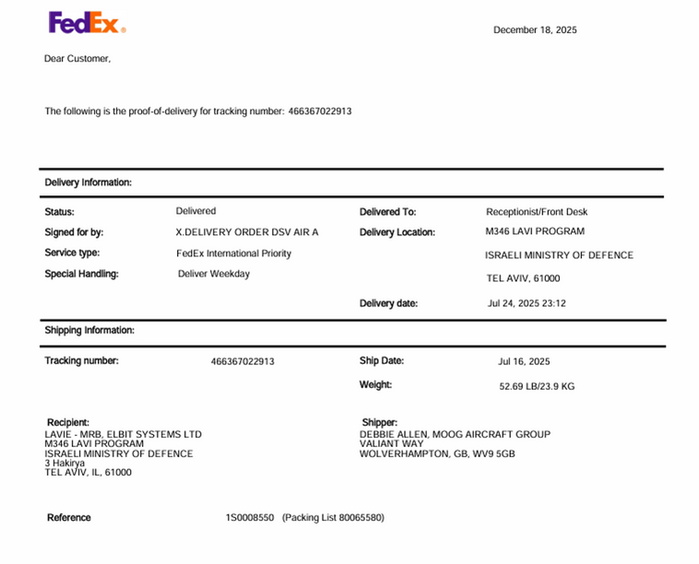
FedEx shipping document of M-346 parts from Moog Wolverhampton to Israel's Ministry of Defence / Elbit Systems Limited
Subsequent reporting by Declassified UK identified further shipments from Wolverhampton to the Israeli Ministry of Defence and questioned ministerial statements that remaining UK arms exports following the September 2024 licence suspensions would not directly support Israeli military operations in Gaza. The reporting argued that continued exports of M-346 components demonstrated that military support extended beyond the government's acknowledged exemption for the multinational F-35 programme. In April 2026, Declassified UK also challenged evidence given to Parliament by Trade Minister Chris Bryant, arguing that official statements had understated the role of UK-manufactured trainer aircraft components in supporting Israeli fighter pilot training. The Department for Business and Trade and the Foreign, Commonwealth and Development Office were asked to clarify the government's position.

Campaign organisations, including Campaign Against Arms Trade (CAAT), contend that the distinction between combat aircraft and trainer aircraft is artificial in the context of an ongoing armed conflict. They argue that supplying the aircraft used to train F-35 and F-16 pilots contributes directly to Israel's operational capability and undermines the rationale advanced by the UK Government for maintaining selected export licences after September 2024. These concerns have become a central focus of campaigning directed at Moog's UK operations and formed part of the background to direct-action protests at the Wolverhampton site.
Other Moog businesses
Other Moog businesses have also shipped extensive quantities of military equipment to Israel since the start of the genocide.
Moog US has been shipping spare replacement parts for F-15 and F-16 fighter jets from their factories in Elma, NY and Torrance, California. According to investigative newspaper Private Eye, Moog Inc. was one of a number of US arms suppliers using East Midlands Airport as a transit hub for shipments of F-15 and F-16 spare parts from the US to Israel, with peaks in such shipments coinciding with peaks in Israeli air strikes against Gaza, Lebanon and Iran. The article went on to note that East Midlands Airport is majority-owned by a consortium of Greater Manchester public authorities, and therefore ultimately under the authority of the Mayor of Greater Manchester Andy Burnham.
Other Moog businesses involved in the supply of military equipment to Israel include Moog's Power and Data Division in Blacksburg, Virginia, which has been shipping electrical connectors and resolvers for use in military aircraft, drones and armoured vehicles and Moog's Protokraft business in Johnson City, Tennessee, which has been shipping electro-optical components for military aircraft and drones.