


The Moog 4 Trials
First Trial - 4-18 June 2026
The trial of the four defendants known by supporters as the "Moog 4" began at Birmingham Crown Court on 4 June 2026 before Mr Justice Wall. The defendants were charged with criminal damage of greater than £5,000 following an action at Moog's Wolverhampton factory in August 2025. Prosecutors alleged that more than signifcant damage had been caused after protesters entered the site, climbed onto the roof and damaged skylights, roof panels and other property.
.jpg)
Birmingham Crown Court

Mr Justice Wall, presiding judge for the first Moog 4 trial and for the retrial, scheduled for 8 March 2027
The defendants did not dispute entering the factory or causing damage. Instead, the central issue throughout the trial was why they had carried out the action. They argued that Moog manufactured flight control components for aircraft supplied to Israel, including the F-35 and Leonardo M-346 programmes, and that disrupting production was intended to help prevent further civilian deaths in Gaza. The prosecution accepted that the defendants' motivation was not in dispute, but maintained that the case was simply one of criminal damage and was "not about the rights and wrongs of the Arab-Israeli conflict." This distinction framed much of the proceedings.
Opening of the Prosecution Case
Opening the case, prosecution counsel Mr Rupert Jones of Citadel Chambers - the same chambers where Mr Justice Wall had previously worked as a barrister - told the jury that the defendants had deliberately targeted Moog's Wolverhampton factory because they believed it formed part of Israel's military supply chain. CCTV footage, drone footage and police evidence were presented showing the group entering the site, climbing onto the roof and causing extensive damage. The prosecution did not provide any evidence quantifying the amount of damage. The contents of the USB drives and images on the T-shirts - of Palestinian civilians killed during the conflict in Gaza - that the defendants had with them when arrested were not disclosed to the jury.
The Crown did not suggest that the defendants intended to harm any individual, and acknowleged that the defendants had not acted recklessly. Instead, it argued that they had intentionally caused substantial damage to commercial property and that their political motivations did not provide a legal defence. Throughout the trial, the prosecution repeatedly emphasised that the jury's task was to determine whether the defendants had intentionally damaged property without lawful excuse. BBC and regional media reporting reflected this framing of the prosecution's case.

Mr Rupert Jones of Citadel Chambers, Prosecuting counsel
Defence Evidence
Each of the four defendants gave evidence.
They accepted participating in the action and explained that they believed Moog supplied essential aircraft components used by the Israeli Air Force. They described their objective as disrupting production and delaying exports rather than harming workers or members of the public. Evidence was heard that the action had been deliberately carried out during a bank holiday when the factory was closed in order to minimise any risk to staff.
One defendant, Iain Evans, a former aerospace industry employee, told the jury that aerospace manufacturing operates on "just-in-time" supply chains and that even relatively short production delays could interrupt deliveries. The defendants said this was the reason they had targeted the factory rather than individuals. They argued that their purpose had been to prevent greater harm by disrupting the supply of military equipment.
During closing speeches, Frank Sherman, representing themself, read Refaat Alareer's poem If I Must Die to explain the moral motivation behind the action. These aspects of the evidence were widely reported by Declassified UK and other outlets covering the trial.
Issues Raised During the Trial
Alongside the factual evidence, the trial attracted attention because of broader legal issues surrounding protest defences.
The defendants argued that they had acted in order to prevent greater harm. Campaign organisations and legal commentators noted similarities with other recent direct-action cases in which juries had been permitted to consider "lawful excuse" or prevention-of-crime arguments. During the proceedings, however, the jury was directed on the legal issues it was entitled to consider, and those directions became a subject of public debate after the trial.
Outside court, the case was also viewed against the backdrop of recent terrorism connection rulings in other protest prosecutions. Although no terrorism offence formed part of the indictment, campaign groups expressed concern about whether terrorism-related sentencing provisions might ultimately be sought if convictions were obtained. These issues were discussed in commentary by CAGE International, Declassified UK and other organisations, although they did not form part of the issues the jury was asked to determine.
Closing Speeches and Jury Deliberations
Mr Rupert Jones closed for the Prosecution by re-affirming to the jury that this was a "simple, open and shut case" and that while the Prosecution did not challenge any of the defendants statements regarding Moog's military exports to Israel, such considerations were irrelevant to the charges in front of them. He went on to say that "if anyone could damage the property of a company they disagreed with, chaos would ensue" and that the "defendants were trying to get away with it."
Mr Tom Wainwright, representing Iain Evans, closed by emphasing the importance of jury independence as a key bulwark of English democracy, going back to the signing of Magna Carta, and that jurors had to take into account everything that they had heard as well as their own personal experience in coming to a verdict. Ms Mira Hammad, representing Hisham Alkhamesi, also focused on the role that juries play in our democracy as a protection against tyranny, citing the famous Bushel's Case of 1670 which established the principle that juries have complete independence and can arrive at a verdict according to their convictions.
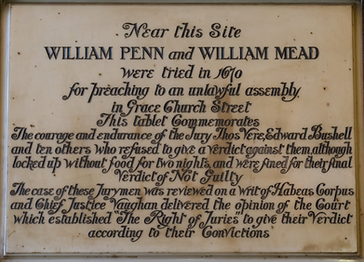
Plaque commemorating Bushel's Case outside the Old Bailey
Frank Sherman represented themself and gave a powerful and moving speech about their experience supporting refugees as a volunteer in Calais, and how this convinced them of the moral importance of taking direct action to save lives when authorities refuse to act.
Ms Ros Burgin, representing Hana Yun-Stevens, provided the final closing speech for the defence, and talked about Hana's upbringing in Korea, her recovery from a severe spinal injury while preparing for Sixth Form exams, working in as a frontline worker in care homes during the COVID epidemic and then while studying for a degree, her experience researching and lobbying her university to stop investing and collaborating with arms companies.
Following closing speeches and the judge's legal directions, the jury retired to consider its verdict.
The jury deliberated for more than 17 hours over four days. During deliberations jurors submitted written questions to the judge seeking clarification about the concept of lawful excuse and asking why evidence regarding defendants motivations and intentions had not been shown to the jury. Mr Justice Wall responded that this evidence was not relevant, after which the jury resumed its deliberations.
After indicating that he would accept majority verdicts, Mr Justice Wall was informed that the jury remained unable to reach verdicts upon which at least ten jurors agreed. On 19 June 2026, he discharged the jury without verdicts on any count. The four defendants were released on bail pending the Crown Prosecution Service's decision on whether to seek a retrial.
Public Reaction
The outcome prompted markedly different reactions.
The defendants were greeted outside the court by supporters who held a one minute silent vigil in memory of all of the victims of the Genocide in Gaza.
Mainstream reporting by the BBC, the Press Association and regional newspapers focused on the hung jury and the Crown Prosecution Service's consideration of a retrial. Campaign organisations including CAGE International and Declassified UK argued that the proceedings raised wider questions concerning the scope of protest defences, the operation of criminal damage law and the use of terrorism-related sentencing provisions in protest cases. The Crown Prosecution Service did not accept those criticisms and subsequently confirmed that it would seek a retrial.
Second Trial - 8 March 2027
At a hearing on 3 July 2026 in Birmingham Crown Court, Mr Justice Wall granted the Crown Prosecution Service a retrial, listed for 8 March 2027 subject to court availability, with the trial scheduled to last 5 days. No changes were made to any of the charges and no variations in bail conditions were sought by the defence.