
Staffordshire Police
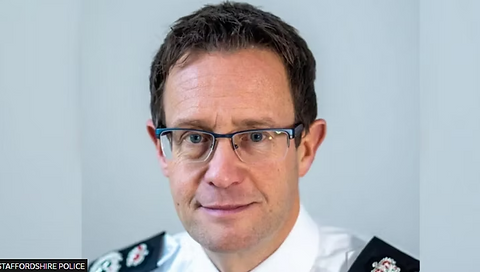
Chief Constable disbarred over Gross Misconduct
On 1 August 2025, Staffordshire Police Chief Constable Chris Noble was suspended by the Staffordshire Police, Fire & Rescue and Crime Commissioner pending investigations by the Independent Office for Police Conduct (IOPC). The Commissioner's office said the suspension followed additional allegations that met the threshold for suspension. The allegations concerning off-duty conduct pre-date Noble's appointment as Staffordshire Chief Constable.
The IOPC also separately investigated allegations that Noble shared confidential information without a proper policing purpose. In March 2026, it was reported that he had been served notice in relation to two further potential gross-misconduct investigations.
On 30 July 2026 it was reported that Noble had been found to have committed gross misconduct and was a result disbarred from the police service. The disciplinary panel said that Noble would have been dismissed if he had not resigned on the Wednesday 29 July, eve of the disciplinary hearing, which concluded the following day in his absence.
Separately, a Freedom of Information request disclosed that Chris Noble had been present at a meeting with the CEO of Eblit Systems UK Ltd, Martin Fawcett and Policing Minister Chris Philp MP, to discuss policing policy in response to increased protests at Israeli-linked arms company facilities in the UK. It is unclear whether Noble has also been present at any similar such meetings with members of Moog management.
Staffordshire Police rated as "Below Adequate" and put into Special Measures
Staffordshire Police has faced repeated scrutiny from His Majesty's Inspectorate of Constabulary and Fire & Rescue Services (HMICFRS). In 2022, the force was moved into the inspectorate's enhanced “Engage” monitoring process - often described as “special measures” - after inspectors found that it was failing to identify and assess vulnerability at the first point of contact and was not carrying out effective investigations or providing victims with sufficient support. The force was removed from Engage in May 2024 after HMICFRS found improvements had been made.
However, the inspectorate's latest assessment, published in July 2026, has again raised significant concerns. Staffordshire Police was graded “Inadequate” for Responding to the Public and “Requires Improvement” for Investigating Crime and Leadership and Force Management. HMICFRS highlighted problems with call handling and attendance times, consistency in investigations, governance and oversight, and the force's understanding of current and future demand.
The latest findings are particularly notable because some of these concerns are not new. HMICFRS said the force's performance in responding to the public remained inadequate despite concerns having been raised previously. Staffordshire Police itself acknowledged that the report identified “several longstanding issues where further progress is required”.
The latest findings are particularly notable because some of these concerns are not new. HMICFRS said the force's performance in responding to the public remained inadequate despite concerns having been raised previously. Staffordshire Police itself acknowledged that the report identified “several longstanding issues where further progress is required”.
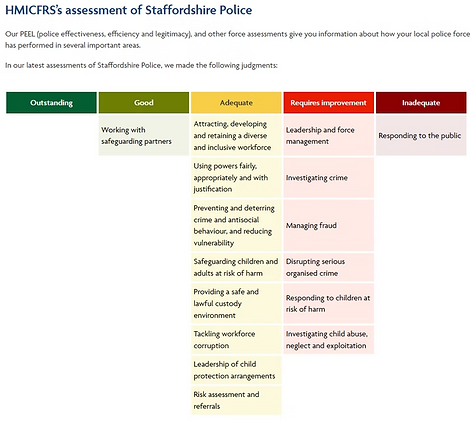
July 2026 assessment of Staffordshire Police
Other misconduct and disciplinary cases
Recent years have also seen a series of serious misconduct cases involving Staffordshire Police officers. In 2025, former Detective Sergeant Aaron Evans was found to have committed gross misconduct after racist and homophobic material was found on his phone and he remained in a WhatsApp group where such content was routinely shared. Former officer Owen Mills was jailed for two years for corrupt and improper exercise of police powers after developing personal and sexual relationships with a vulnerable woman and a witness he had encountered through his duties.
In March 2026, PC David Henzell was dismissed without notice after a misconduct panel found that he had sexually harassed a colleague, made inappropriate sexual comments to another colleague and slept while on duty. Three months later, former Sergeant Tim Rees was found to have committed gross misconduct after having a sexual relationship with a student officer on his team; Staffordshire Police's Deputy Chief Constable described abuse of position for a sexual purpose as “a serious form of corruption”.
In July 2026, serving Staffordshire Police officer Alex Trusler pleaded guilty to four counts of sexual assault following an investigation by the force's Anti-Corruption Unit. These cases are separate and do not establish misconduct by Staffordshire Police as an institution. They do, however, form part of the wider recent record against which questions of leadership, supervision and organisational performance at the force may reasonably be considered.
Staffordshire Police and Moog's Contacts before 26 August 2026
Documents filed by Moog in its subsequent High Court injunction proceedings reveal that the company's contact with Staffordshire Police began after an approach from journalist John McEvoy of Declassified UK. On 1 July 2025, McEvoy emailed Moog saying that Declassified was preparing an article based on shipping documents concerning the company's supply of aircraft components to Israel. Moog did not respond to the allegations. The article, Israeli Fighter Pilots Training with UK Equipment, was published on 10 July.


Moog Inc General Counsel Elwira Kelly
According to the sworn witness statement of Moog General Counsel Elwira Kelly, a Moog employee contacted Staffordshire Police on 1 July, the same day as McEvoy's initial approach, to raise concerns about a possible threat from Palestine Action. On 4 July, a South Staffordshire Local Policing Team officer visited the factory, reviewed McEvoy's email, discussed safety in the event of a protest and examined the site's external security measures. Police returned on 7 July to review risks and advise on possible protest-control measures; further discussions took place on 10 and 11 July, and police attended again on 22 July.
Moog's evidence states that uniformed officers then regularly patrolled the Wolverhampton site after the Declassified article was published. The action on 26 August therefore took place after almost two months of contact between Moog and Staffordshire Police concerning the specific risk of Palestine-related direct action at the factory.
This is somewhat in contrast to Freedom of Information data released by Staffordshire Police, which records 27 police callouts associated with Moog's Wolverhampton site between 2018 and 2025, including three commercial burglaries, three suspicious incidents and two criminal-damage reports, alongside false alarms and other incidents. The data did not separately identify any previous protest-related callouts.
These pre-incident contacts were not explored in evidence during the first Moog 4 trial, despite the prosecution relying extensively on police analysis reconstructing the defendants' activities and planning before 26 August.
Police surveillance and information sharing with Moog
Moog's own High Court evidence raises further questions about the relationship between the company and Staffordshire Police. In a sworn witness statement, Moog stated that one of the Moog 4 had been “observed attending PA rallies”. The statement did not explain who had observed the defendant, how they had been identified, or whether information or imagery had been shared between Moog, its private security contractors and the police.
A subsequent Freedom of Information request asked Staffordshire Police whether it had data-sharing arrangements with Moog, whether CCTV or still images had been exchanged, and whether automated, live or manual facial-matching processes had been used in connection with protests at Moog sites. Staffordshire Police refused even to confirm or deny whether such information existed, citing both law enforcement and national security. The force argued that acknowledging the existence or absence of such arrangements could reveal surveillance capabilities, protective strategies or vulnerabilities relating to critical infrastructure.
The refusal leaves a simple question unanswered: how did Moog know that a subsequently arrested defendant had previously attended rallies against arms exports to Israel? Staffordshire Police has separately confirmed that it holds records of liaison with Moog concerning protest risk, site security and protective measures, but has withheld those records because of the ongoing criminal investigation.
References
BBC, 2026, "Police chief suspended over conduct allegations"
BBC, 2026, "Police chief faces further misconduct probes"
BBC, 2024, "Police force exits special measures"
BBC, 2026, "Police force 'inadequate' at responding to public"
HMICFRS PEEL Assessment, Staffordshire Police, 2025-2027
BBC, 2025, "Officer would have been sacked for racist videos"
BBC, 2026, "PC sacked for sexually harassing colleague"
BBC, 2026, "Police officer admits sexual assaults"
Moog Injunction (2025), "EK Statement 1"
Staffordshire Police (2026), "Freedom of Information Request FOI 21906 Moog Aircraft Group"
Staffordshire Police (2026), "Freedom of Information Request FOI 22051 Moog Aircraft Group"

Questions That Still Need Answers
The relationship between Staffordshire Police, Moog and the policing of protest raises important questions about surveillance, information sharing and accountability.
Explore the wider evidence surrounding the Moog 4 case and decide for yourself what these connections reveal.